

Development Standards: The Invisible Operating System That Enables Scaling Without Burning Out the Team

If you’ve already noticed that your projects don’t follow a clear guideline, this is for you: what happens
when there are no standards, why it’s more costly than it seems, and how to build the
minimum useful without bureaucracy._
What would happen if a new developer joined your team tomorrow?
Take a moment and think about it seriously.
How long would it take them to set up the development environment? Where would they find the
naming convention the team uses? Would someone explain how to name a
branch, what a PR should include, or how the system modules are organized?
If the answer is “they ask someone on the team” or “they have to learn on the fly,” you already have a diagnosis.
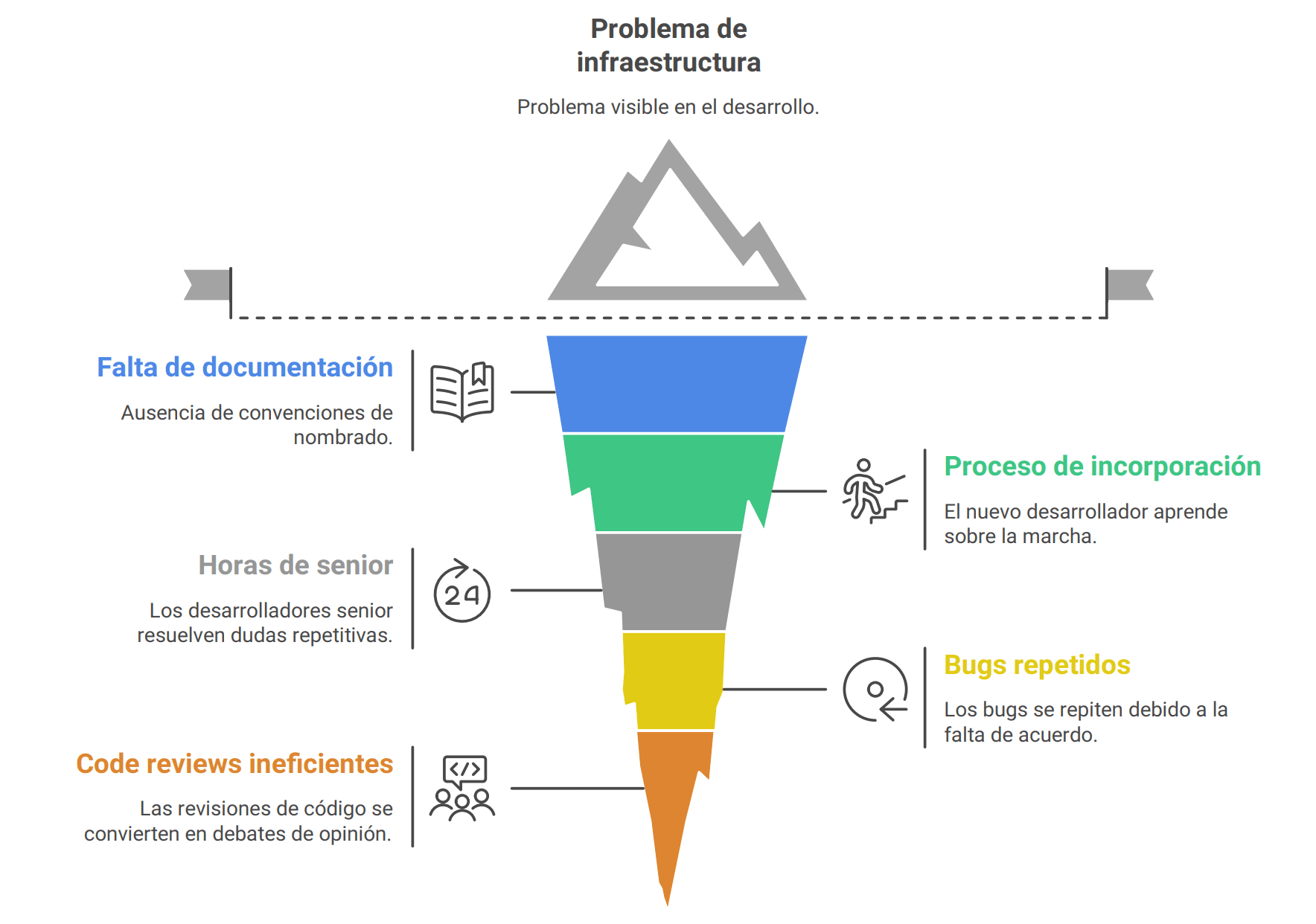
It’s not a talent problem. It’s a problem of invisible infrastructure.
And the cost is not seen in a metric. It accumulates in hours of seniors solving doubts that shouldn’t
reach them, in bugs that repeat because no one agreed on how to avoid them, in
code reviews that turn into opinion debates instead of technical checkpoints.
Invisible infrastructure affects team productivity.
Tacit knowledge doesn’t scale
Most development teams have standards. The problem is that those standards
live in the heads of the oldest team members, not anywhere transferable.
When the team is small and stable, it holds up. But when it starts to grow, or
when there is turnover, or when the project is inherited, the consequences are predictable:
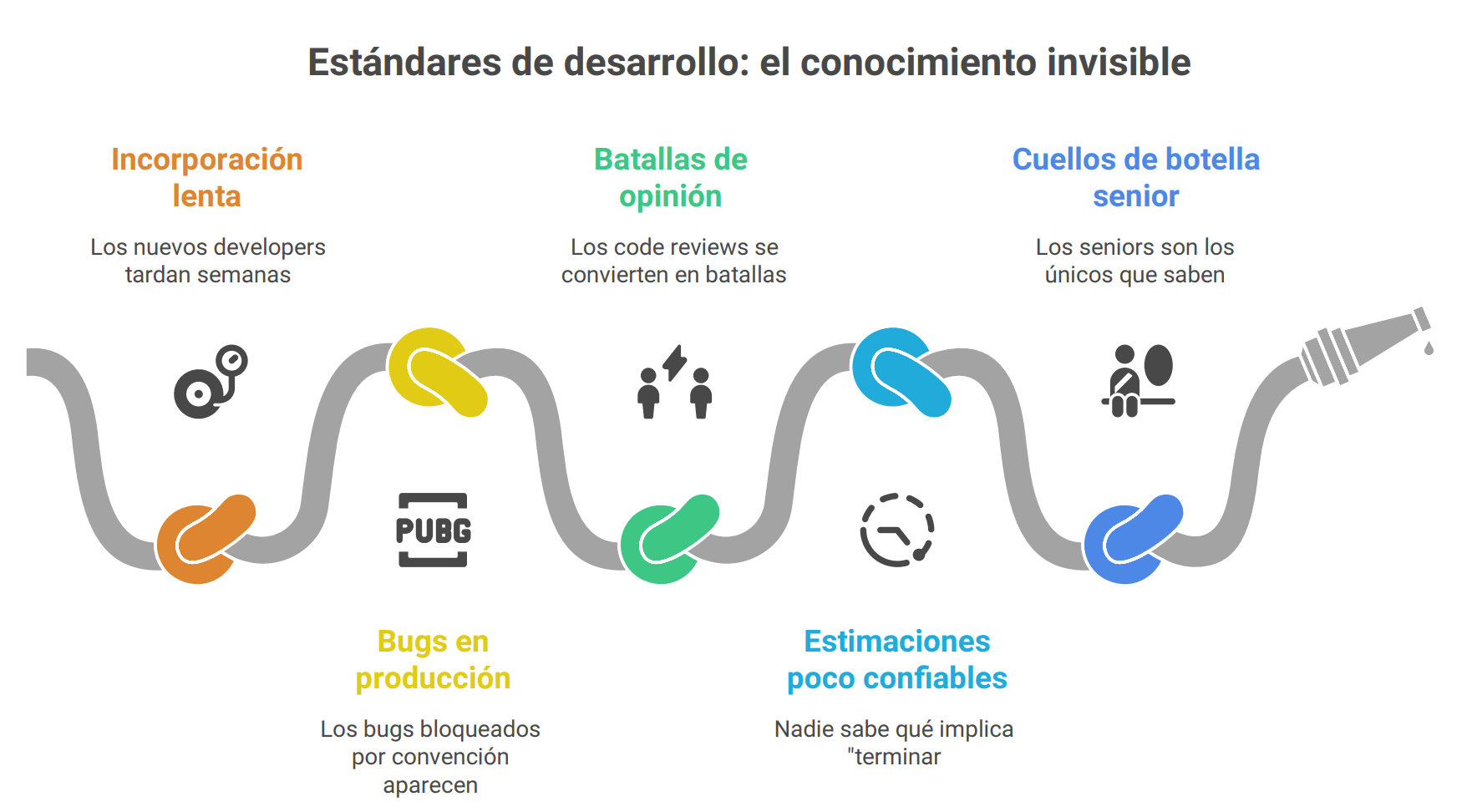
- New developers take weeks to be productive, not days.
- Bugs that should be blocked by convention appear in production.
- Code reviews turn into opinion battles instead of technical checkpoints.
- Estimates become unreliable because no one knows what “finishing”
- something implies.
- Seniors become unintentional bottlenecks because they are the only ones
If you’ve identified it, you’re at the best moment to act
Recognizing that projects don’t follow a clear guideline is not a sign that the
team is bad. It’s a sign that the team grew faster than its internal infrastructure.
It happens in almost every engineering team that scales.
The question is not whether to put things in order, but how to do it without it becoming a
heavy process that no one adopts.
There is only one question worth asking to start: What does someone
joining today need to know to be productive tomorrow? Not perfect documentation. The minimum useful.
In the teams we’ve worked with at Kranio, 80% of operational chaos comes
from the absence of agreements in five specific areas.
The pragmatic minimum standard: 5 areas, 20 agreements
This is not a methodological framework. It doesn’t require certifications or a 6-month
adoption process. It’s the distilled result of what we’ve seen work in teams
that went from chaos to consistency.
1. Code and naming conventions
- Naming of variables, functions, and classes follows an explicit convention (camelCase, snake_case, PascalCase depending on context).
- Code comments: when yes, when no, and in what language.
- Maximum size of functions and files (e.g., functions of maximum 40 lines).
- How to handle magic values (named constants, not loose numbers).
- Design pattern: organized folders, single responsibility.
2. Git workflow
- Branching strategy: GitFlow, trunk-based, or the team’s variant —
- documented.
- Convention for branch names (feat/, fix/, chore/, hotfix/).
- What a commit message should include (type, scope, imperative description).
- PR rules: what to include in the description, how to link tickets, how many reviewers.
3. Code review process
- Reviewer’s minimum checklist (logic, tests, security, performance).
- Review SLA: maximum X hours before the PR is blocked.
- How to give feedback: nitpick vs. real blocking.
- Criteria to approve without waiting for everything to be perfect.
4. Testing standards
- What requires mandatory unit testing and what does not.
- Minimum coverage to consider a feature "ready" (e.g., 70% in business logic).
- How to name tests (given-when-then or the team's style).
- Integration and e2e test policy: when and how.
5. Technical onboarding
- Development environment setup in less than 2 hours (script or step-by-step doc).
- Map of system modules: what each does, where it is, who knows it.
- First ticket for a new member: small, real, and with a clear definition of done.
- Technical questions channel: where to ask without feeling like you're interrupting.
How to implement it without bureaucracy
The most common trap is wanting to implement everything at once, in a three-hour meeting,
with a 40-page document that no one will read.
What works:
Sprint 1
Document what you already do. Don’t invent new standards. Ask: how do we do
this today? Write it down. The goal is to make the implicit explicit.
Sprint 2
Identify the most costly frictions. Where are the most hours lost? Where do repetitive bugs appear? Prioritize checklist areas by real impact, not theory.
Sprint 3
Progressive adoption with a clear owner. Each area has a responsible person. Not a committee. One person who updates, defends, and evolves that standard.
Afterwards
The standard lives where the code lives. README, repo wiki, or Notion linked to
the project. Not in a Confluence or Google Drive folder that no one opens.
Measurable results: what we saw in 90 days
In projects where we have supported the implementation of minimum standards, the
most consistent changes in the first three months are: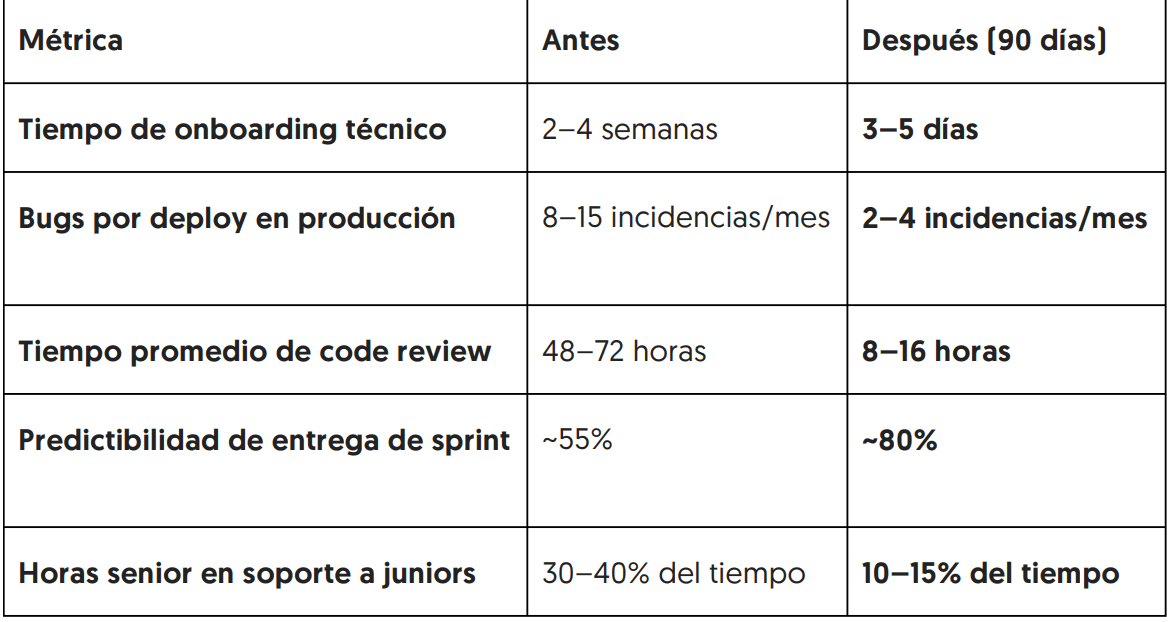
The standard is not an obstacle. It is the accelerator.
When teams hear "development standards" the first reaction is usually
resistance. Bureaucracy. Process for the sake of process. Overhead.
But the reality of teams that implement them well is exactly the opposite:
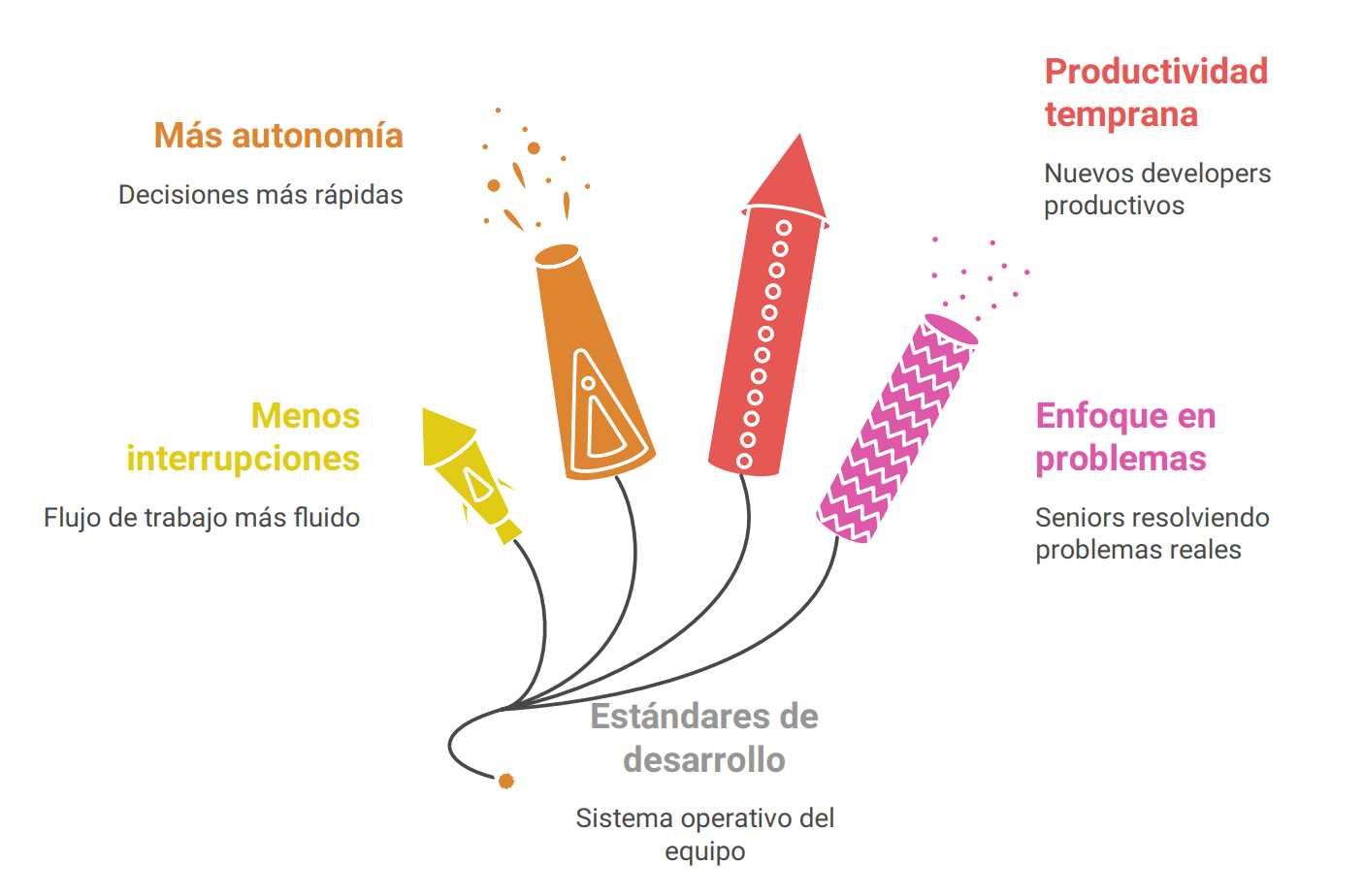
fewer interruptions, more autonomy, faster decisions because there is no need to debate what
is already agreed upon.
Imagine how your team’s dynamics would change if new developers were
productive in their first week. If deploys no longer needed someone available
to put out fires. If seniors could focus on solving real problems instead of
answering the same questions over and over.
_Standards are the team’s operating system. You don’t see them when everything works. But
when they’re not there, everything else fails._
Development standards improve team productivity
Is your team scaling without clear standards?
At Kranio we support engineering teams in building the technical and
cultural infrastructure that allows growth without burnout. Let’s talk about where
the friction is and how to solve it.
Let’s talk →
Previous Posts

Google Apps Scripts: Automation and Efficiency within the Google Ecosystem
Automate tasks, connect Google Workspace, and enhance internal processes with Google Apps Script. An efficient solution for teams and businesses.

Augmented Coding vs. Vibe Coding
AI generates functional code but does not guarantee security. Learn to use it wisely to build robust, scalable, and risk-free software.